Table of Contents
Form Factors, Chemistry and Voltage
Modern life is not possible without AA and AAA batteries. They power everything from TV remotes and portable milk frothers to tons of small IoT sensors.
Standard AA and AAA batteries use alkaline chemistry and are rated at 1.5 V. You may also have heard of rechargeable batteries in the same sizes. These usually work as drop-in replacements, but they are typically Ni‑MH and rated slightly lower, at 1.2 V.
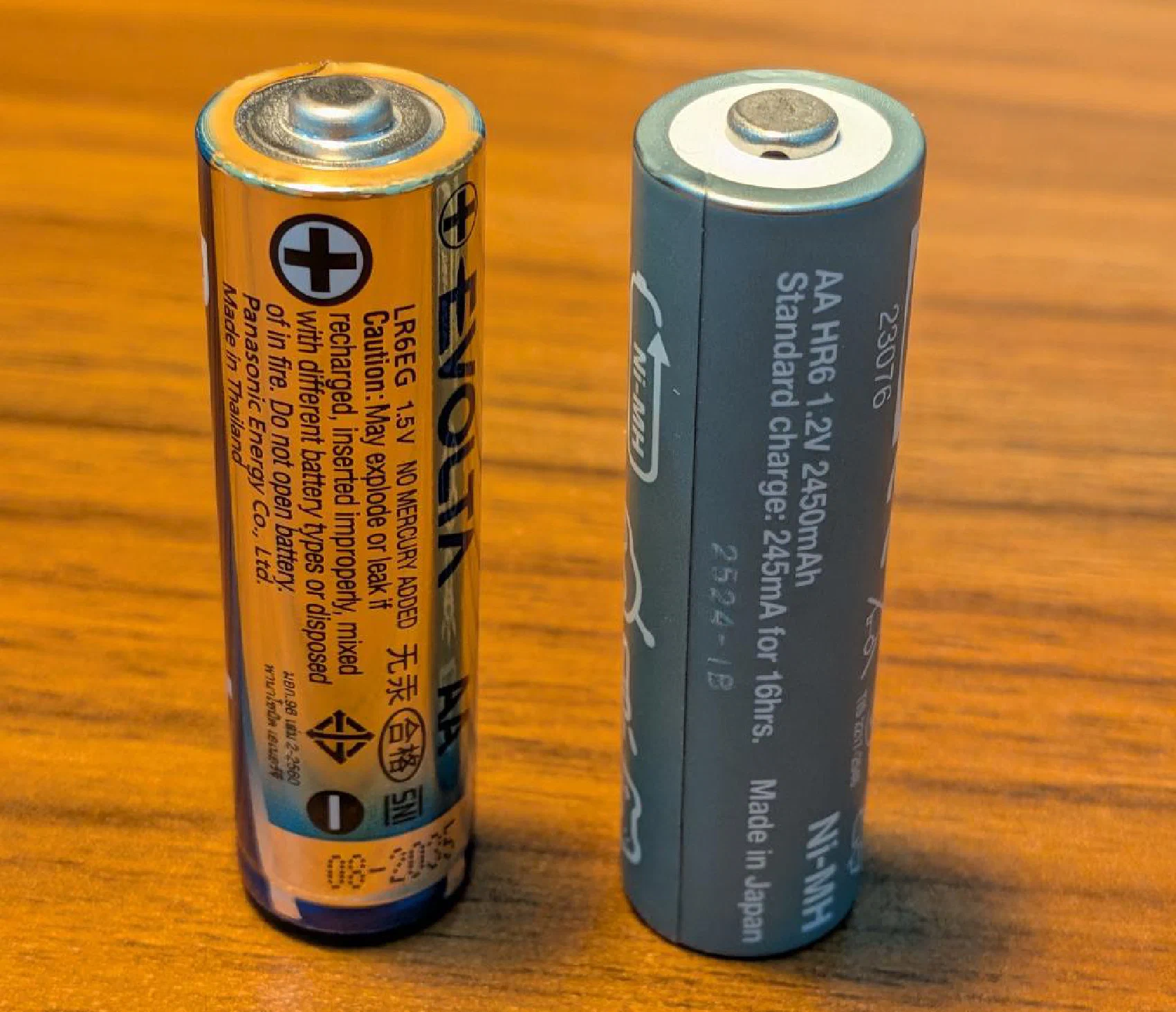
In practice, this voltage difference is usually not an issue, unless your device needs to report battery status or has some voltage-sensitive sensors. Many devices are hardwired for 1.5 V, and using 1.2 V rechargeables is not completely risk-free.
So we know AA and AAA sizes don’t define chemistry, or even expected voltage. And it gets even more mixed up. There are also at least two other varieties available in those sizes:
- AAA Li‑ion 3.7 V
- AAA LiFePO4 3.2 V
Self‑Discharge Rate
Batteries can’t hold a charge forever, even if you don’t use them. That’s why some people have a bad experience with rechargeable batteries in their remotes.
Remotes are low‑power devices, and most of their power draw can come from the battery’s self‑discharge. Some cheap Ni‑MH batteries lose 10% or more of their charge per month. Putting those in a remote is a terrible idea, because you’ll have to recharge them every few months.
IKEA LADDA cells are high‑quality and rumored to be rebranded Eneloops. They’re supposed to last for years, but I wanted to test that myself. I also added Li‑ion and LiFePO4 cells to the mix to compare self‑discharge rates between different chemistries. Both of those are made by Soshine, which is a solid brand.
Batteries Tested
| Battery | Capacity | Nominal Voltage | Chemistry |
|---|---|---|---|
| IKEA LADDA AA | 2450 mAh | 1.2 V | NiMH |
| IKEA LADDA AAA | 750 mAh | 1.2 V | NiMH |
| Soshine AAA | 280 mAh | 3.2 V | LiFePO4 |
| Soshine AAA | 350 mAh | 3.7 V | Li‑ion |
All four were fully charged on 2025‑12‑23 and left sitting on a shelf, untouched, at room temperature.
Voltage Over Time
| Battery | 2025-12-23 | 2026-01-27 | 2026-04-30 | 2026-06-30 |
|---|---|---|---|---|
| LADDA AA | 1.440 V | 1.320 V | 1.300 V | 1.314 V |
| LADDA AAA | 1.470 V | 1.320 V | 1.300 V | 1.317 V |
| LiFePO4 | 3.390 V | 3.340 V | 3.340 V | 3.340 V |
| Li‑ion | 4.170 V | 4.120 V | 4.120 V | 4.140 V |
Estimated Charge Remaining
| Battery | Initial | 1 month | 4 months | 6 months |
|---|---|---|---|---|
| LADDA AA | 100% | ~90% | ~80‑90% | ~80‑90% |
| LADDA AAA | 100% | ~90% | ~80‑90% | ~80‑90% |
| LiFePO4 | 100% | ~98% | ~98% | ~98% |
| Li‑ion | 100% | ~98% | ~98% | ~98% |
The NiMH cells lost the most, and almost all of that loss happened in the first month. After that, the voltages barely moved. The LiFePO4 and Li‑ion cells are essentially unchanged.
Misconceptions
Rechargeable batteries die in a few weeks in low‑power devices like TV remotes.
Only true for cheap, non‑low‑self‑discharge (LSD) NiMH cells. Modern LSD NiMH (Eneloop, IKEA LADDA, Panasonic) lose almost nothing. LiFePO4 and Li‑ion are also surprisingly durable. None of the four cells above are anywhere close to dead after six months.
All rechargeable batteries self‑discharge at roughly the same rate.
No. Cheap NiMH can lose 10%+ per month. Quality NiMH loses nothing after a slight initial drop. LiFePO4 and Li‑ion lose around 1% per month or less. Battery chemistry and build quality matter a lot.
Rechargeables are bad for remotes and other low‑drain devices.
The opposite is true. Remotes draw so little current that battery self‑discharge dominates. A good rechargeable will work fine for many years.
AA and AAA define battery chemistry.
They only define the form factor. You can buy alkaline, NiMH, Li‑ion (3.7 V), or LiFePO4 (3.2 V) cells in AA and AAA sizes. Plugging a 3.2 V or 3.7 V cell into a device expecting 1.5 V will damage it, but 1.2 V is usually fine.
Self‑discharge is the reason your phone, laptop or Nintendo Switch dies overnight.
Unlikely. Blame software.
Alkaline batteries are better because they don’t self‑discharge.
They do, sometimes way faster than rechargeables.
Conclusion
Over six months on a shelf, a quality NiMH cell loses roughly 10‑20% of its charge at most, while LiFePO4 and Li‑ion barely budge. The big drop, when it happens, is in the first month. After that, the curve flattens.
If a device goes flat within days of being unused, the battery isn’t the problem, the software is keeping the device awake and power hungry.