Table of Contents
Preface
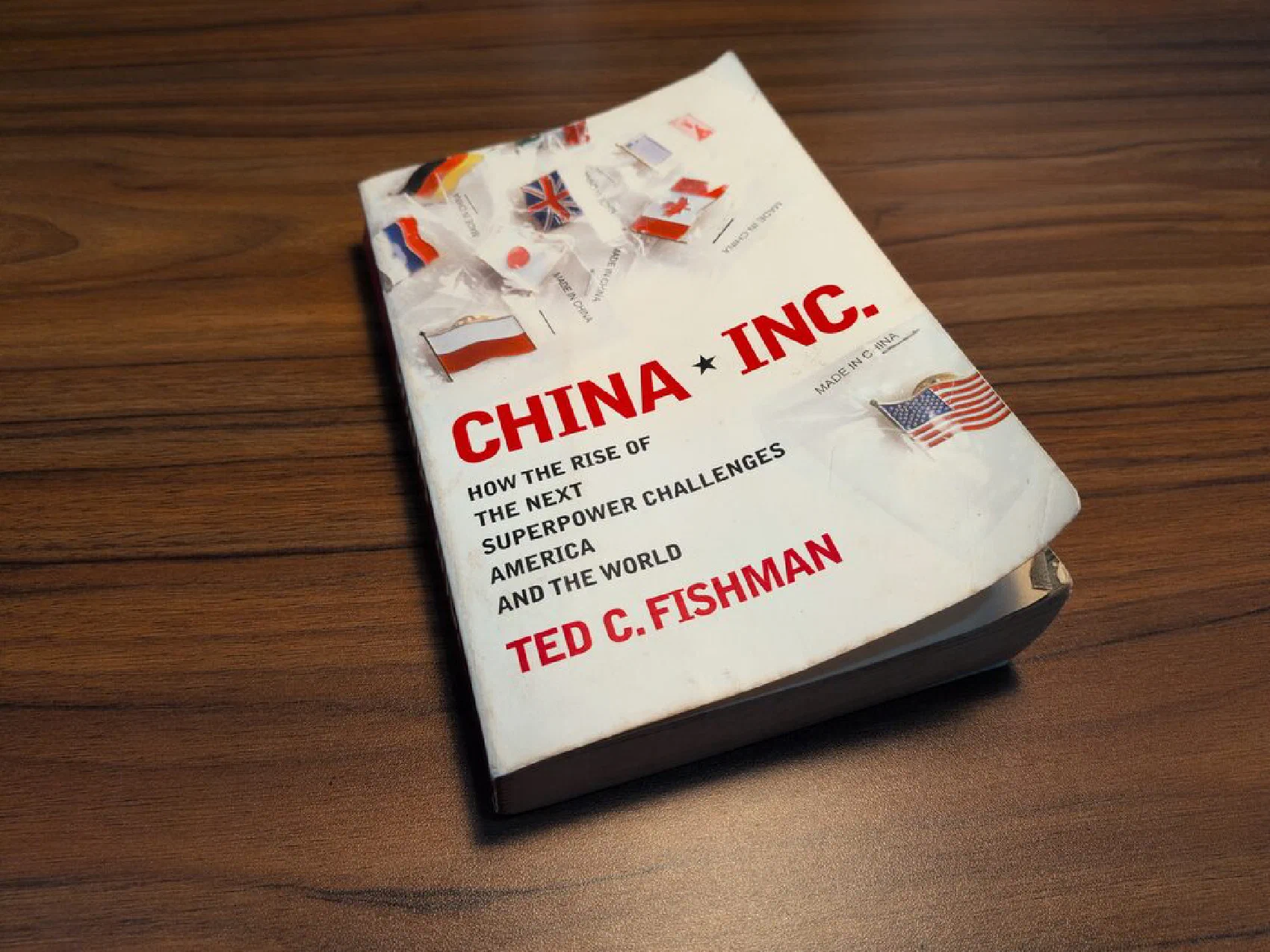
I found this book by accident, glancing at the shelves of a used book store in Phuket Old Town.
China Inc came out in 2005 and it’s now more than twenty years old, which is pretty exciting. That means every perspective in it can be checked against what actually happened.
Most books about China I come across were written in the last couple of years, which makes them less trusted since it’s harder to find honest and neutral reporting when superpower rivalry has already entered a fairly advanced stage.
There’s also something appealing about reading a book that has already been proven wrong or right in public. The author had no idea how the story would end, and neither did anyone else at the time.
Key Takeaways
China Inc is mostly a book about economics and development. Fishman focuses on factory owners, migrant workers, and local officials, and writes about that with no visible editorializing.
The part I found most valuable is how it treats today’s “shocks” as plans that were already decades in the making. Electric vehicles, solar panels, shipbuilding, and the rest of it were being planned and built decades ago.
Most of the book’s predictions got the direction right: China would stay on its growth path, absorb manufacturing from the rest of the world, and become a serious technological competitor. Where the book missed is the speed of economic and social development, and almost everyone missed that by a wide margin.
Quotes
Instead, every time the worst is predicted for China’s economy, it seems to grow faster, create stronger industries, import and export more, and attract more foreign investment money.
Japan and Germany currently enjoy large trade surpluses with the country because China is now the world’s biggest buyer of factory machinery, and it needs the equipment Germany and Japan make in order - yes - to produce the machinery and electronics that Germany and Japan make.
And then there are the big products themselves: cars, trucks, planes, ships, switching networks for national phone systems, factories, submarines, satellites, and rockets. China is taking on those industries too.
Not all, or most, or even a third or fifth of its population needs to reach the middle class for the world to chase its markets - a mere 50 million families is enough.
While the rest of the world’s press leads with war news, celebrity scandals, or political coverage, the Chinese press logs top in every contest it publicly places itself.
The United Nations predicts that by 2010, the vast influx of rural residents to the cities will boost China’s rate of urbanization to 45 percent, and by 2030 to 60 percent.
The UN was too conservative here. China ended 2010 at 49.95 percent, almost five percentage points above the forecast, and crossed the 60 percent mark in 2019, more than a decade before the deadline. The National Bureau of Statistics puts the urbanization rate at 67.89 percent at the end of 2025.
The Chinese Communists, steeped in Marx, knew that the early stages of capital accumulation in a market economy taking shape were bound to be messy. Europe had its pirates and privateers, America its robber barons, Japan and Korea had their corrupt zaibatsus and chaebols, the cozy interlocking conglomerations of banks, industry, politicians, and the military, all willing to scratch each other’s back and hide each other’s sins.
China’s citizens have the highest rate of savings in the world, socking away, on average, forty percent of their income.
Two decades later the habit is still there. The household saving rate has drifted down to roughly 35 percent, which remains the highest in the world by a wide margin. Fitch puts it at 35.3 percent in 2025, after holding flat at 34.9 percent in 2023 and 2024. Lower deposit rates and years of stimulus have barely moved it.
China forced prices in Europe down 42 percent, in part because the young women of Shenzhen work so hard, so long, and for so little.
Only 15 percent of the Chinese have safe drinking water that comes out of a tap.
I couldn’t find reliable data to test this one, but the general advice is still to avoid drinking tap water in China.
One of Motorola’s most important suppliers is the battery maker BYD Company Ltd, based in Shenzhen, near Hong Kong. In only a decade, the private company has gone from virtual invisibility to owning more than 50 percent of the global market in mobile-phone batteries.
BYD outgrew phone batteries a long time ago. In 2025 it installed 194.8 GWh of EV batteries, 16.4 percent of the global market, second only to CATL. It also sold 4.6 million new energy vehicles, which made it the world’s largest NEV seller and the sixth largest automaker by total sales, ahead of Ford.
The United States cannot take on ever-bigger debt and amass huge trade deficits indefinitely.
“When Asians pull out of our markets, Americans may discover abruptly that interest rates climb and the value of the assets - stocks, homes, businesses, almost everything - declines,” Frankel says. “When other countries have gone through similar crises, people panicked. Whether such a crisis might lead the U.S. to also lose much of its political power, it is hard to say. It is certainly possible.”
Competitiveness requires a highly educated workforce. On that score, the news in America is not promising, especially when one looks at grade schools and high schools where the vast majority of American students are not getting the skills they will need to be sharp enough to flourish in a future informed by China.
How close is the United States to a competitive crisis? After all, China has yet to introduce the kind of world-changing technology or consumer products that are the hallmark of advanced economies. But it will. The genius that has so far poured into creating great factories will soon be evident in great products and great brands that will offer the world unsurpassed quality and refinement: Japan will have to share the shelves in high-end electronics and photo shops, France and Italy will vie with China in the luxury apparel and accessory market; and South Korea will have trouble staying ahead of Chinese shipbuilders.
South Korea did have trouble. Chinese yards won 63 percent of global newbuilding orders in 2025, against 21 percent for Korea, and their share rose to 72 percent in the first half of 2026. The Chinese orderbook now covers more than 70 percent of the world total, so the lead is not going away soon.
Conclusion
China Inc was a fun read overall. It reads fast, the economics is always tied to real people, and the characters are memorable.
What surprised me most were the numbers. The savings rate, the pace of urbanisation, and Shenzhen’s wage growth history were all far outside my expectations.