Note: this only reflects my personal work this month. Visit the BTC Map Blog for consolidated monthly reports.
Table of Contents
Dashboard
I started a new internal project this month: BTC Map Dashboard. It is a small static site that talks to the BTC Map API and renders the analytics snapshot from the new dashboard RPC. I kept it deliberately tiny: no bundler, no framework, no build step, just plain HTML, CSS, and a few ES modules. The goal is to give admins a quick health check without having to SSH into our servers.
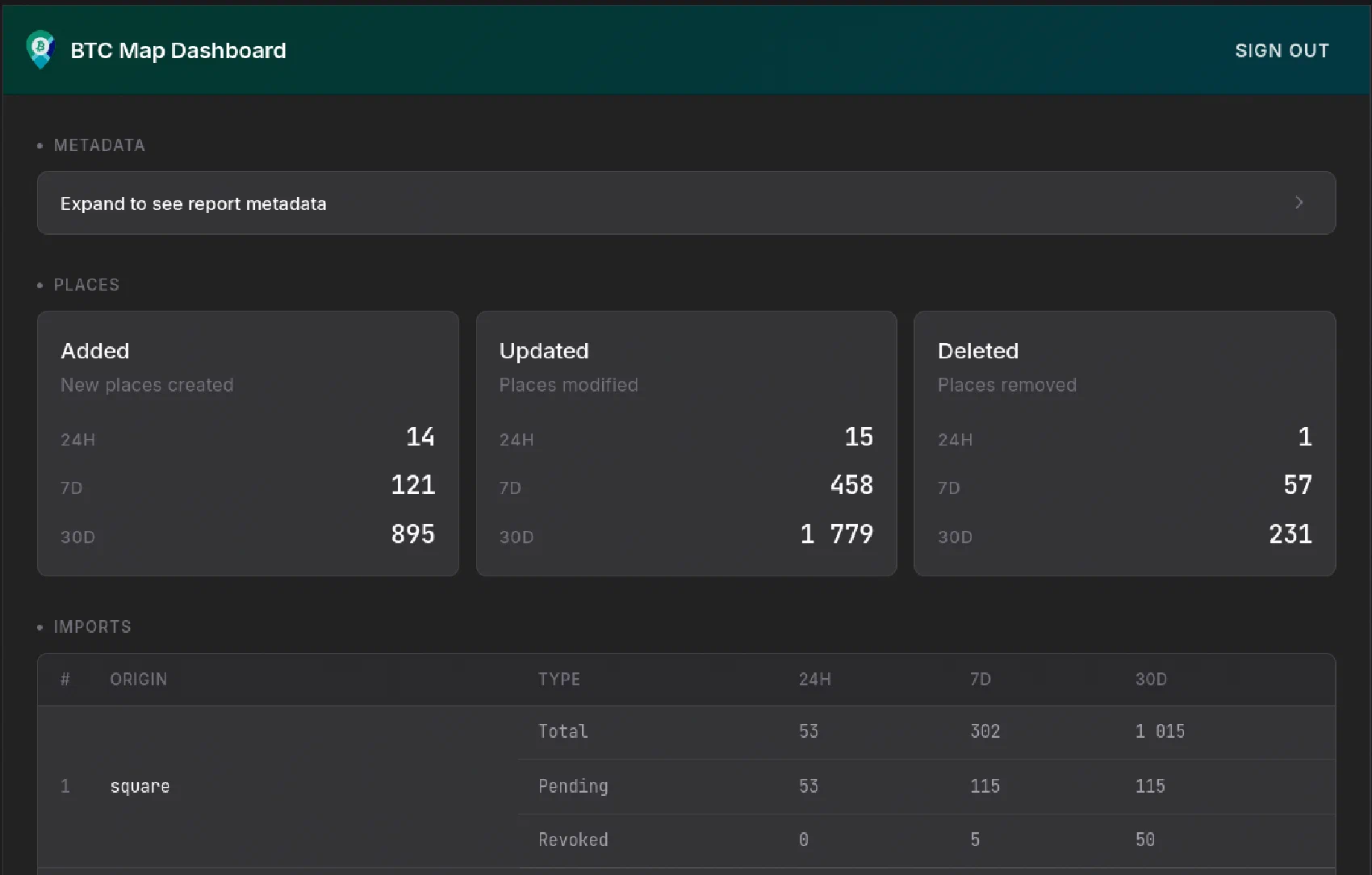
API
The biggest chunk of my month went into the API.
Auth
I finally stabilized RPC auth flow for third party integrations:
signupis the new registration endpointsigninissues an access tokensignoutrevokes the current tokenget_api_keysandrevoke_api_keylet users inspect and invalidate their active sessionswhoamireturns the linked account
All non-auth RPCs now require an authenticated session. Anon access is limited to signin and signup. I also added support for scoped tokens, so the dashboard can be issued a token that can only call dashboard and nothing else.
Area Images
This is the feature I am most excited about, after the dashboard. Up to now, area icons and banners were scattered between the main DB, the filesystem, and a few half-broken scripts. I introduced a dedicated image.db table for area images, plus a new v4/area-image REST endpoint with type and dimensions hints.
Place Import Stats
Place import origins used to be hardcoded in a few Rust constants, which made it painful to onboard new wallets and merchant sources. I moved them into a dedicated DB table and exposed stats on the dashboard endpoint, including per-origin success/failure counts. A few long-dead endpoints and startup checks were deleted along the way.
Observability
The dashboard RPC now also returns log volume and counts of logged requests over the 1/7/30-day windows. A new top_rest_api_calls block lists the ten busiest REST endpoints in the last 24 hours, which is useful for spotting abuse and unintentional hot paths. I also added LND and storage stats to the same response, refactored the log queries, and started logging HTTP methods on every request.
Maintenance
I bumped geojson to 1.0, unpegged the Rust toolchain, refreshed dependencies, and added native CORS handling so we can stop relying on the reverse proxy for it. The old btcmap.db and images.db files were renamed to main.db and image.db to match the rest of the naming.
CLI
The CLI now speaks the new auth API. signin returns the token under the api_key field, signout revokes the current token. I added two area image commands (generate-area-icons and set-area-image) and a simple install script, and reorganized the command tree now that there are quite a few subcommands.
Website
The tagging-issues and leaderboard pages were still hitting now authorized-only JSON-RPC endpoints. I migrated them to the public REST API, so our website is now finally RPC-free.
Android
Local activity feed got filter support, so users can scope it to a specific area and period. I also optimized area image loading and added a dedicated activity feed icon. MapLibre and a few other key dependencies were bumped.
Ansible
Image database backups were not actually happening. I added image.db to the backup playbook, updated the snapshot script, and pruned a couple of dead helper files.
Future Plans
No exact plans, but I’ll probably be improving dashboard and working towards a new Android app release.